Why your swim instructor should be in the water with you
Teaching from the deck works for strong swimmers. For a beginner, it helps to have someone beside you in the water.
October 27, 2026 · 2 min read
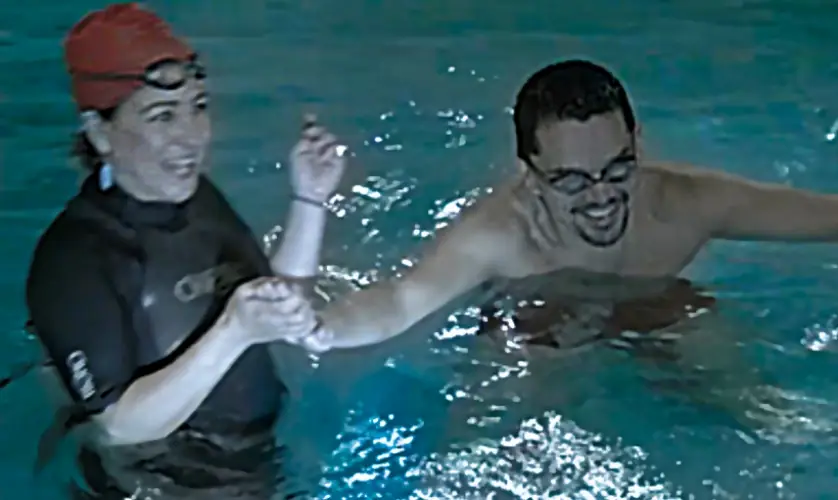
Picture two first lessons. In one, the instructor stands on the tile and calls out: kick from the hips, relax your neck, breathe out. In the other, the instructor is standing beside you in the water with a hand under your back.
Both can work for someone who already swims. For a beginner, most of what needs fixing cannot be fixed with words from several feet away.
What a hand can say that a voice cannot
Body position is the biggest thing a new swimmer gets wrong, and it is almost impossible to feel from the inside. Your hips sit low, your head lifts, your legs hang. An instructor in the water can lift your hips slightly, turn your head back to neutral, and let you feel the difference in a few seconds.
The same goes for floating. A student can hear "relax" ten times and still stay rigid. A steadying hand under the shoulder blades tells the body it is safe to let go, and the float often follows.
Demonstration beats description
Swimming is physical and mostly visual. It is far easier to copy a flutter kick from two feet away than to decode one from a sentence. AquaSkills says its instructors go in the water with you and teach by demonstrating, and lists it among the ways it differs from schools where instruction happens from the deck.
Being in the water changes what an instructor can do: show a stroke at your eye level, mirror your movement, and catch a mistake while it is still small. In a pool 15 feet wide, there is room to do that right next to you.
There is a practical side too. A student who is told to kick harder often just tires out. An instructor in the water can see that the kick is coming from the knees and not the hips, hold your ankles for a moment, and show the right motion before the habit sets.
Fear needs a person, not a clipboard
For an adult afraid of the water, an instructor next to them is often the thing that makes the first attempt possible. You can say "wait" and be heard at once. You can see their face. If you panic, they are already within reach.
AquaSkills states that its instructors are American Red Cross certified lifeguards, with CPR, AED and First Aid training. An instructor in the water with you is also one who is trained to handle trouble in it.
What to look for when you compare schools
Ask any school how its lessons are run. Is the instructor in the water for the lesson, or on the deck? How many students share one instructor? How long is a class? AquaSkills describes its classes as one hour long and offers private lessons, with one student and one instructor, plus semi-private lessons for two or more students. Those are the school's own descriptions, and a first lesson is the way to check them for yourself.
The intro class at AquaSkills is $98 per person, and you are not obligated to continue. Lori Pailet directs the school and conducts classes herself in New York City. To book, text (646) 724-7024.
AquaSkills, (212) 206-6976
Call (212) 206-6976More articles
Learning to swim as an adult in New York: what the first lesson covers
Before you book, it helps to know exactly what happens in the water, step by step, and why the steps come in that order.
Fear of water is usually about one moment: putting your face in
You may be fine standing in the water. The trouble starts when your face goes under, and that can be taught one small step at a time.